

Keeping Your Cool: How Engine Mounting and Damping Solutions Protect Powertrains and Passengers
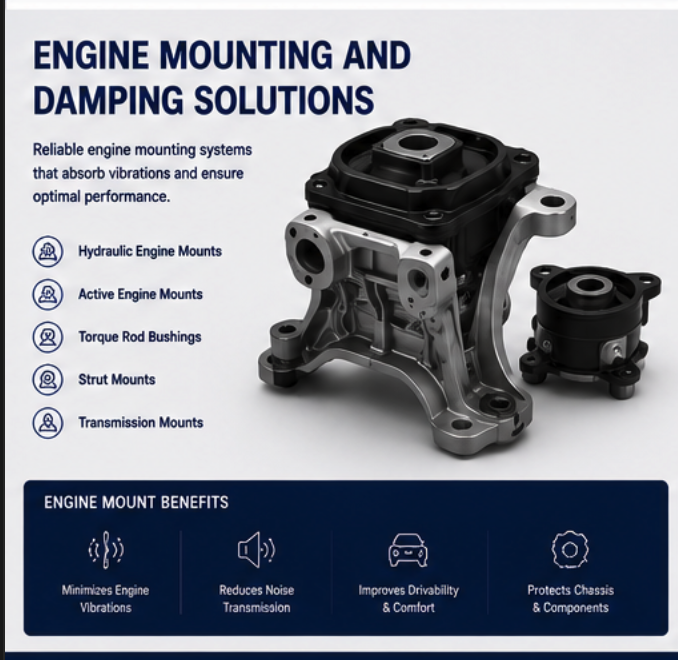
The engine and transmission assembly is the heaviest, most powerful, and most vibration-prone component in any vehicle. Connecting it to the chassis without transmitting destructive forces is a fundamental engineering challenge. Engine Mounting and Damping Solutions address this challenge, using Vehicle NVH Reduction Components to isolate the powertrain while controlling its motion under torque. These mounts are the critical interface between power and comfort.
The Three Functions of Engine Mounts
Engine mounts must perform three conflicting jobs simultaneously:
Function 1: Support Static Weight
The engine and transmission weigh 150-300 kg (330-660 lbs). Mounts must support this weight continuously without sagging or creeping over time.
Function 2: Control Dynamic Motion
Under acceleration, the engine tries to rotate opposite to the wheels (torque reaction). Under braking, it tries to pitch forward. Under cornering, it tries to shift laterally. Mounts must control these motions to prevent the engine from hitting other components.
Function 3: Isolate Vibration
The engine produces vibration from combustion events (firing pulses) and rotating imbalance. Mounts must isolate these vibrations from the chassis—otherwise, the entire vehicle would shake.
These three functions often conflict. A stiff mount controls motion well but transmits vibration. A soft mount isolates well but allows excessive engine movement. Engineers use advanced designs to reconcile these demands.
Engine Mount Construction
A typical rubber engine mount consists of:
-
Metal brackets: Attach to the engine and chassis.
-
Rubber element: Provides isolation and elasticity.
-
Metal inner sleeve: Bonded to rubber, receives mounting bolt.
-
Snubber (optional): Additional rubber to limit motion in specific directions.
Engine Mounting and Damping Solutions use several design variations:
Compression Mounts:
The rubber is compressed between engine and chassis brackets. Simple and durable, but progressive stiffness (stiffer as load increases). Common on rear-wheel-drive vehicles.
Shear Mounts:
The rubber is loaded in shear (twisting). Soft isolation but limited load capacity. Common on smaller engines.
Torque Struts (Dog Bones):
A separate rod with bushings at each end. Connects the engine to the chassis specifically to control torque reaction without adding vertical stiffness. Used on transverse (front-wheel-drive) engines.
Hydraulic Engine Mounts
For premium isolation, hydraulic mounts replace solid rubber with fluid-filled chambers. Construction includes:
-
Rubber body: The primary structure.
-
Upper fluid chamber: Filled with glycol or oil.
-
Lower fluid chamber: Separated by a diaphragm.
-
Inertia track: A restrictive passage connecting the chambers.
-
Decoupler: A floating disc that opens under high amplitude.
How Hydraulic Mounts Work:
-
Low amplitude, high frequency (engine idle): The decoupler opens, fluid moves freely through the inertia track. The mount acts as a soft damper, canceling idle vibration.
-
High amplitude, low frequency (acceleration, braking): The decoupler closes, fluid movement is restricted. The mount acts as a stiff spring, controlling engine motion.
Hydraulic Vehicle NVH Reduction Components are the standard for modern vehicles, offering the best of both worlds—soft for idle, stiff for driving.
Active and Semi-Active Engine Mounts
The ultimate evolution is active mounts, which use external energy to adapt in real-time:
Semi-Active Mounts (Switchable):
An on/off valve in the fluid passage. At idle, the valve is closed, fluid moves through a tuned track (soft). At higher RPM, the valve opens, fluid moves freely (stiffer). Simple and effective.
Active Mounts (Fully Controlled):
An electromagnetic actuator applies force to the mount. A sensor monitors engine vibration. The controller commands the actuator to cancel the vibration in real-time. Active mounts can eliminate idle shake entirely.
Mount Placement and Load Path
Most vehicles use three or four mounts:
Three-Mount System (Transverse Engines):
-
Left mount (near timing belt/chain)
-
Right mount (near transmission bellhousing)
-
Rear mount (on transmission, torque strut)
Four-Mount System (Longitudinal Engines):
-
Left and right (engine block to frame rails)
-
Rear (transmission to crossmember)
-
Front (engine front cover to radiator support)
Torque struts add additional motion control without adding vertical stiffness.
Failure Modes and Symptoms
Engine mounts do not last forever. Typical life is 80,000-120,000 miles, depending on duty cycle.
| Failure Mode | Cause | Symptoms |
|---|---|---|
| Rubber deterioration | Heat, ozone, age | Cracking, visible dry rot |
| Bond separation | Overload, fatigue | Clunking on acceleration/deceleration |
| Fluid leakage (hydraulic) | Ruptured diaphragm | Sudden increase in idle vibration |
| Collapse (sagging) | Overload, fatigue | Engine sits lower, clunking |
| Torque strut wear | Bushing failure | Excessive engine movement, clunking |
Diagnosing Failed Engine Mounts:
-
Visual inspection: Check for cracked rubber, leaking fluid, or separated bonds.
-
Power brake test: With the engine running and brakes firmly applied, shift between Drive and Reverse. Watch engine movement (should be minimal).
-
Road test: Accelerate and decelerate briskly. A clunk or thud indicates excessive mount movement.
-
Idle test: With the vehicle stationary and in Drive/Neutral, feel for excessive vibration in the steering wheel or seat.
Replacement Considerations
Replacing Engine Mounting and Damping Solutions is often more complex than it appears:
-
Access: Rear and front mounts may require removing many components.
-
Hydraulic compatibility: Replacement mounts must match original fluid characteristics.
-
Torque procedures: Bolts must be torqued precisely; some require one-time-use fasteners.
-
Alignment: The powertrain must be positioned correctly before tightening.
Some vehicles require removing the engine or transmission for mount replacement—a multi-hour job.
Upgraded Mounts: Performance and Durability
Aftermarket Vehicle NVH Reduction Components offer alternative characteristics:
| Mount Type | Stiffness | NVH | Best For |
|---|---|---|---|
| OEM replacement | Stock | Stock | Daily driver |
| Stiffer rubber | +20-50% | Increased | Performance street |
| Polyurethane | +50-100% | Significant | Track car |
| Solid metal (race) | Infinite | Extreme | Race only |
Performance mounts reduce engine movement (sharper throttle response) but transmit more vibration to the cabin. Solid metal mounts are undriveable on the street.
The Future: Integrated and Smart Mounts
Emerging trends in Engine Mounting and Damping Solutions include:
-
Integrated mounts: Mounts with built-in sensors for real-time load monitoring.
-
Magnetorheological mounts: Rubber with iron particles, stiffness controlled by magnetic field.
-
Predictive mounts: Connected to GPS/navigation, mounts pre-adjust for known road conditions.
-
EV-specific mounts: Electric motors require different tuning (no firing pulses, but high-frequency whine).
Conclusion
The engine mount is a masterpiece of compromise—balancing support, motion control, and isolation. Engine Mounting and Damping Solutions have evolved from simple rubber blocks to sophisticated hydraulic and active systems. As part of a complete suite of Vehicle NVH Reduction Components, they ensure that the engine's power is felt at the wheels—not through the steering wheel. Next time you accelerate smoothly, thank your engine mounts.

 English
 Arabic
 French
 Spanish
 Portuguese
 Turkish
 Dutch
Dutch
 Italiano
 Russian
 Romaian
 Portuguese (Brazil)
 Greek
Greek