

How Pizza Flour Impacts Dough Texture, Crust Quality, and Baking Performance
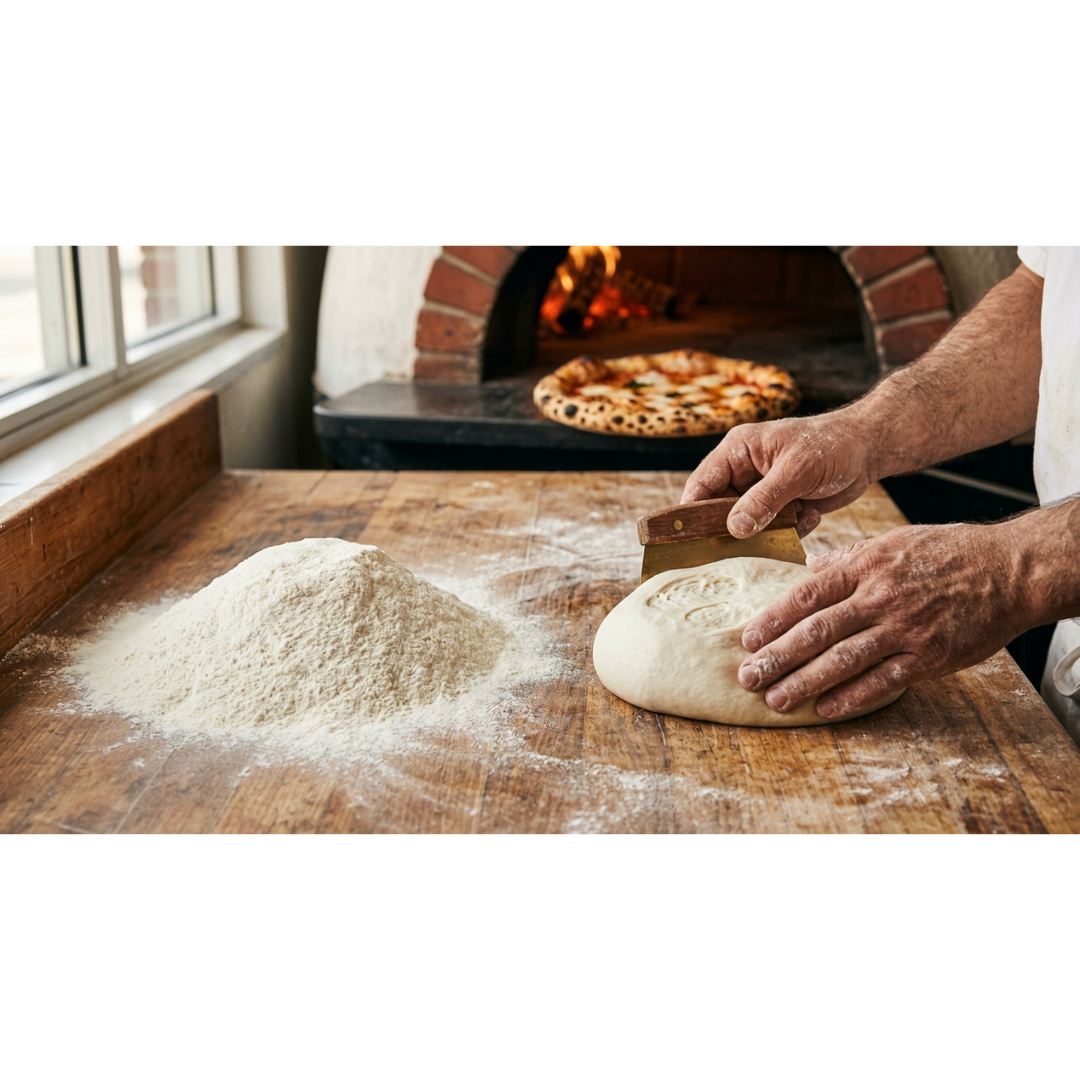
Every great pizza begins long before the toppings are added or the oven is fired up. It starts with the flour. Pizza flour is the foundation of everything the dough feel, the crust structure, the browning, and the overall eating experience.
For professional chefs and pizzaiolos, understanding how pizza flour behaves at every stage of production is not optional it is essential.
This blog walks you through exactly how pizza flour influences dough texture, crust quality, and baking performance, giving you the technical clarity to make smarter decisions in your professional setup.
Why Pizza Flour Is a Specialized Ingredient
Pizza flour is not just any milled wheat. It is carefully engineered to meet the specific demands of pizza production. The milling grade, protein content, ash level, and starch quality all work together to define how the flour behaves during mixing, fermentation, shaping, and baking.
The most widely respected grade in professional pizza production is the "00" classification an ultra-fine milling standard that delivers exceptional dough smoothness, even hydration, and outstanding extensibility.
Pizza flour at this grade is the preferred choice for Neapolitan, Roman, and contemporary artisan pizza styles across commercial bakeries and professional setups worldwide.
How Pizza Flour Shapes Dough Texture
Dough texture is the first place where pizza flour makes its presence felt.
The protein content in pizza flour typically ranging between 12% and 14% — directly controls gluten network development. A well-structured gluten network means:
-
Smooth, pliable dough that stretches without resistance
-
Consistent elasticity across large production batches
-
Strong gas retention during proofing for a light, open crumb
-
Minimal spring-back during hand-stretching and shaping
The ultra-fine particle size of 00 pizza flour also plays a major role.
Fine milling ensures water is absorbed evenly throughout the dough mass, eliminating inconsistencies and producing a uniform, workable texture that professional bakers can rely on shift after shift.
When pizza flour is used correctly with calibrated hydration ratios, the dough feels noticeably silkier and more cooperative a quality that becomes especially important in high-volume production environments.
The Direct Impact on Crust Quality
Crust quality is where pizza flour truly demonstrates its value.
Professional bakers evaluate crust performance across three critical areas:
Crispness at the Base
A precisely milled pizza flour with the right starch composition allows the crust base to develop excellent crispness in high-heat ovens — without becoming overly dry or brittle.
The result is that satisfying snap when the slice is lifted.
Internal Chewiness and Structure
The gluten framework formed by pizza flour creates an open, airy interior with the right amount of chew.
This is the texture profile that distinguishes a professionally made pizza from anything less.
Browning and Color Development
The Maillard reaction and caramelization during baking depend significantly on the flour's sugar and starch profile.
Quality pizza flour produces the signature golden-amber crust color with subtle blistering especially visible in the cornicione — that signals a truly well-baked pizza.
Baking Performance Across Professional Oven Environments
One of the strongest indicators of a quality pizza flour is how consistently it performs across different oven types:
Wood-fired ovens (400–500°C)
Pizza flour handles extreme temperatures efficiently, producing a fast bake with excellent char development and structural integrity.
Deck ovens (280–320°C)
The flour's hydration capacity supports a controlled bake, delivering consistent crust quality across multiple cycles.
Conveyor ovens
Reliable extensibility and fermentation stability in pizza flour ensure uniform results across high-volume, continuous production runs.
This cross-oven performance reliability is what makes choosing the right pizza flour a strategic decision for any professional operation.
Fermentation Compatibility and Production Scheduling
Quality pizza flour is built to support extended fermentation from 24-hour to 72-hour cold fermentation schedules.
Extended proofing with the right pizza flour delivers:
-
Richer, more complex flavor development through enzymatic activity
-
Improved dough digestibility
-
Superior gas retention and crumb structure
-
Greater production flexibility for chefs managing multi-day prep schedules
This fermentation stability gives professional teams predictable, consistent dough performance even after extended cold rest periods.
Final Thoughts
Pizza flour is not a background ingredient it is the core performance driver in every pizza you produce.
From dough texture and fermentation behavior to crust quality and oven performance, pizza flour influences every outcome that matters in a professional production setting.
Choosing the right pizza flour means choosing consistency, quality, and confidence in every batch you deliver.
Frequently Asked Questions
Q1: What protein percentage should professional chefs look for in pizza flour?
For most professional pizza styles, a protein content between 12% and 14% is ideal. Higher protein levels suit thicker, chewier crusts, while the lower end works well for thin, crisp bases.
Q2: Why is 00 pizza flour preferred in professional production?
The ultra-fine milling of 00 pizza flour delivers superior dough smoothness, even hydration, and better extensibility — all critical factors in professional pizza production across commercial bakeries and large-scale operations.
Q3: Can pizza flour handle long cold fermentation schedules?
Absolutely. High-quality pizza flour is specifically designed to remain stable and perform consistently through extended 24 to 72-hour cold fermentation schedules, making it well suited for planned production workflows.
Q4: How does pizza flour affect crust color during baking?
The starch and natural sugar composition in pizza flour directly influences Maillard browning, helping develop the golden-amber crust color with characteristic blistering that professional bakers consistently aim for.
Q5: Is pizza flour suitable for all commercial oven types?
Yes. A well-formulated pizza flour performs reliably across wood-fired, deck, and conveyor ovens making it a versatile and dependable choice for professional operations of all scales and output volumes.

 English
 Arabic
 French
 Spanish
 Portuguese
 Deutsch
 Dutch
Dutch
 Italiano
 Russian
 Romaian
 Portuguese (Brazil)
 Greek
Greek