

Shielding the Cabin: How Vehicle Sunshade Systems Are Enhancing Driving Comfort
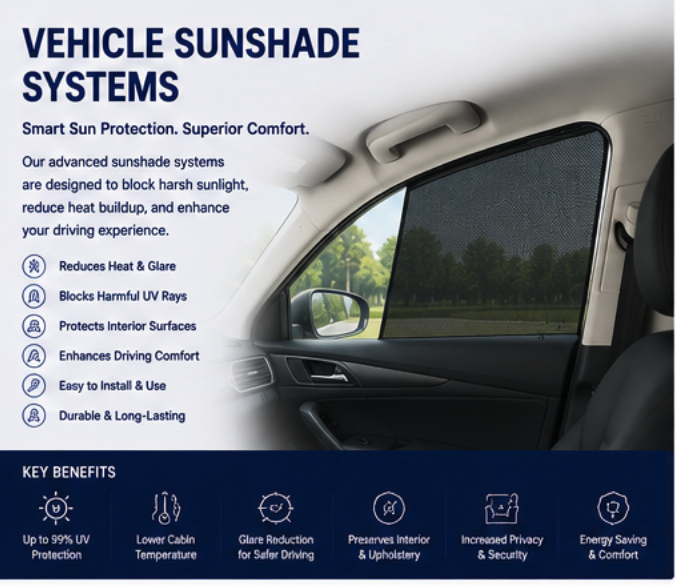
There is nothing quite like driving into the setting sun, squinting against the glare, or feeling the back of your neck burn on a summer road trip. For decades, drivers and passengers have endured these discomforts as unavoidable facts of automotive life. But modern Vehicle Sunshade Systems are changing that reality. These systems, which include everything from simple mesh screens to sophisticated retractable blinds, are designed to block glare, reduce heat buildup, and protect interior materials from UV damage. Working alongside Automotive Window Privacy Screens, they create a more comfortable, private, and refined cabin environment for all occupants.
The Problem: Glare, Heat, and UV Damage
Sunlight entering a vehicle through windows creates three distinct problems:
Glare and Visibility Issues:
Direct sunlight or reflections off other vehicles can temporarily blind drivers. Sun visors block forward glare but do nothing for side or rear windows. Glare from the rear window (through the rearview mirror) is particularly distracting.
Heat Buildup (Greenhouse Effect):
Solar energy passing through glass is absorbed by interior surfaces (seats, dashboard, carpets) and re-radiated as heat. With windows closed, this heat cannot escape. The cabin temperature can rise 30-40°F (17-22°C) above outside temperature in minutes.
UV Damage:
Ultraviolet radiation degrades interior materials:
-
Leather: Cracks, fades, loses suppleness.
-
Fabric: Fades, weakens, stains become permanent.
-
Plastic: Becomes brittle, discolors, cracks.
-
Electronics: Screens and displays can delaminate.
Vehicle Sunshade Systems address all three problems by blocking solar radiation before it enters the cabin.
Types of Vehicle Sunshade Systems
Sunshade systems vary by placement, operation, and materials:
By Window Location:
| Location | Purpose | Common Vehicle Types |
|---|---|---|
| Rear windshield | Blocks rear glare, reduces cabin heat | All passenger vehicles |
| Rear side windows (passenger) | Passenger comfort, privacy | SUVs, sedans, luxury cars |
| Rear side windows (cargo) | Privacy for cargo area | Station wagons, SUVs |
| Sunroof/moonroof | Reduces heat, blocks glare | Vehicles with glass roofs |
By Operating Mechanism:
| Type | Operation | Best For |
|---|---|---|
| Manual (pull-up/pull-down) | Hand-operated | Economy cars, aftermarket |
| Electrical (motorized) | Button or integrated with window controls | Premium and luxury vehicles |
| Semi-automatic | Spring-assisted manual | Some OEM installations |
Manual Sunshades:
The simplest and most affordable option. The passenger pulls the shade up from a housing at the bottom of the window and hooks it onto clips at the top.
Advantages:
-
Low cost ($50-200 per window as an option).
-
Simple, durable (few moving parts).
-
No electrical integration needed.
-
Easy to replace.
Disadvantages:
-
Requires passenger effort.
-
Cannot be operated from driver's seat.
-
May not be usable if window is open.
Electric (Motorized) Sunshades:
The premium option, typically integrated into the rear window shelf or door panel. A small electric motor raises and lowers the shade at the touch of a button.
Advantages:
-
Convenient (operate from driver's seat).
-
Can be integrated with window controls (lower shade when reversing).
-
Looks integrated (no visible clips or hooks).
-
Can be linked to reverse gear (automatically lower for better visibility).
Disadvantages:
-
Expensive ($200-500 per window as an option).
-
Motor can fail (repair cost is high).
-
Adds weight (small but measurable).
Materials: Blocking the Sun
Automotive Window Privacy Screens use various materials:
| Material | Light Blocking | UV Blocking | Heat Reduction | Characteristics |
|---|---|---|---|---|
| Mesh | 50-80% | 90-95% | Moderate | See-through from inside, privacy from outside |
| Fabric (opaque) | 95-99% | 98-99% | High | Complete privacy, no outward visibility |
| Polyester | 70-90% | 95-98% | Moderate | Durable, low cost |
| PVC/Vinyl | 80-95% | 98-99% | High | Waterproof, easy to clean, heavy |
| Aluminum-coated | 95-99% | 99% | Very high | Reflective, best heat rejection |
Mesh vs. Opaque:
-
Mesh: Allows occupants to see out while making it difficult to see in. Reduces glare without completely blocking vision. Common for rear side windows.
-
Opaque: Blocks all light and vision. Used for cargo privacy or when passengers want complete darkness (napping children).
UV Protection: A Health Feature
Prolonged UV exposure through car windows is a genuine health concern. Studies show that side windows block less UV-A than windshields (which are laminated). Rear side windows in many vehicles offer minimal UV protection.
UV Transmission by Glass Type:
| Glass Type | UV-B Block | UV-A Block |
|---|---|---|
| Laminated windshield | 98-99% | 95-98% |
| Tempered side glass (factory) | 95-98% | 50-70% |
| Tempered side glass with tint | 99% | 90-95% |
| Mesh sunshade (alone) | 90-95% | 85-90% |
A quality sunshade adds significant UV protection, especially for rear-seat passengers (often children).
Heat Reduction: Keeping the Cabin Cool
Solar heat entering through windows is the primary cause of cabin overheating. Sunshades reduce this heat load.
Heat Reduction Effectiveness:
| Shade Type | Solar Heat Reduction |
|---|---|
| No shade | 0% |
| Light mesh (50% blocking) | 20-30% |
| Dark mesh (70% blocking) | 40-50% |
| Opaque fabric (95% blocking) | 60-70% |
| Reflective (aluminum-coated) | 70-80% |
A cooler cabin means less air conditioning use, improving fuel economy (or EV range) by 5-10% in hot weather.
Privacy: A Security Feature
Automotive Window Privacy Screens also serve a security function. By blocking the view into the rear cabin, they:
-
Deter theft: Potential thieves cannot see valuables left in the back seat or cargo area.
-
Provide passenger privacy: Rear-seat passengers (especially VIPs or families) can travel without being observed.
-
Reduce distraction: Other drivers cannot make eye contact with rear passengers.
Integration with Vehicle Electronics
Modern Vehicle Sunshade Systems integrate with other vehicle systems:
Reverse Gear Interlock:
When the driver selects reverse gear, electric rear window shades automatically lower to improve rear visibility. They raise again when shifting out of reverse.
Window Interlock:
Some systems prevent the shade from raising if the window is open (to avoid damage). Others automatically lower the shade slightly when the window is opened.
Memory Function:
Retains the shade position (raised or lowered) when the vehicle is turned off and restores it when restarted.
Child Lock Integration:
Prevents rear-seat passengers (children) from operating the shades.
Aftermarket vs. OEM Sunshades
Vehicle Sunshade Systems are available both as factory equipment (OEM) and as aftermarket accessories:
| Aspect | OEM (Factory) | Aftermarket |
|---|---|---|
| Fitment | Perfect (designed for specific vehicle) | Universal or vehicle-specific (varies) |
| Installation | Installed at factory | DIY or professional |
| Appearance | Integrated, matches interior | May look added-on |
| Cost (as option) | $200-500 (often part of package) | $30-200 |
| Quality | Very high | Varies widely |
| Warranty | Included with vehicle | Seller-dependent |
Aftermarket options are popular for older vehicles or budget-conscious buyers.
The Future of Vehicle Sunshade Systems
-
Electrochromic (smart) glass: Glass that darkens on demand (no physical shade). Already available on some sunroofs.
-
Integrated roller shades: Shades that roll up into the headliner (not door panel), offering a cleaner look.
-
Solar-powered shades: Small solar cells on the shade surface power the electric motor (no vehicle wiring needed).
-
Voice control: "Alexa, raise the rear shades."
-
Thermal sensing: Shades automatically deploy when cabin temperature exceeds a set threshold.
Conclusion
The humble sunshade has evolved from a simple accessory to a sophisticated comfort and convenience feature. Vehicle Sunshade Systems protect passengers from glare and UV radiation, keep cabins cooler, and provide privacy for occupants and cargo. Whether manual or electric, mesh or opaque, these systems are an essential part of the modern Automotive Window Privacy Screens ecosystem. Next time you drive into the sunset, you will appreciate the shade.

 Arabic
 French
 Spanish
 Portuguese
 Deutsch
 Turkish
 Dutch
Dutch
 Italiano
 Russian
 Romaian
 Portuguese (Brazil)
 Greek
Greek